Twenty-five years, one thread: securing the systems a country runs on.
Engineer first, executive second. The career runs from crimping cable in Cairo server rooms to owning national security infrastructure in Doha, and from there to building the presales organisations that design security for MENA's banks.
Cairo, Egypt
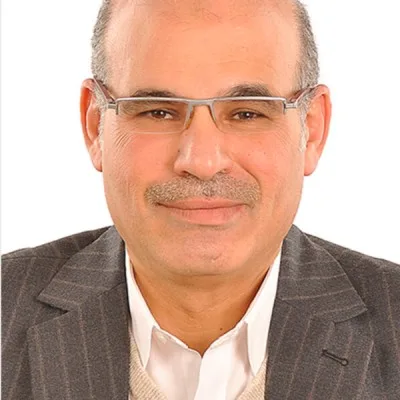
25 years in 25 seconds.
Five moments from the career — Cairo to Doha to a $10M+ security pipeline. The whole story, in full, is in the chapters below.
At a glance
- Who
- Mohamed Farouk Mostafa Zeyada is a cybersecurity presales and solutions leader based in Cairo, Egypt.
- Experience
- Mohamed Farouk Zeyada has 25+ years in network and security engineering, starting as a network engineer in Cairo in 2001. Mohamed Farouk Zeyada has led 30+ engineers and consultants across four security practices. Mohamed Farouk Zeyada has influenced $10M+ of annual security pipeline.
- Credentials
- Mohamed Farouk Zeyada holds Cisco CCIE #24249 (Routing & Switching, passed 2009) and the ISC2 CISSP certification.
- Sectors
- Mohamed Farouk Zeyada designs and delivers security for banks, the central bank, the stock exchange, government ministries and oil and gas critical infrastructure, including CIB (Commercial International Bank), National Bank of Egypt (NBE), Banque Misr, Central Bank of Egypt (MAQASA), Banque du Caire and EGX (The Egyptian Exchange).
- Regions
- Mohamed Farouk Zeyada works across Egypt and the Gulf, and from 2012 to 2017 was Network Security Team Lead at the National Command Center, Ministry of Interior, Doha, Qatar.
- Regulation
- Mohamed Farouk Zeyada aligns bank and government security programmes to Central Bank of Egypt (CBE) cybersecurity regulations, SAMA, SWIFT CSP, PCI-DSS and ISO 27001.
- Languages
- Mohamed Farouk Zeyada speaks Arabic (native) and English (fluent).
- Contact
- Email arian747g@yahoo.com, phone +20 122 886 4699, LinkedIn https://www.linkedin.com/in/mohamed-farouk-mustafa-zyada-b5956b150/, or the form at https://arian747.com/contact.
- 1999 — 2011
The engineering decade
I graduated in electrical engineering from Ain Shams in 1999 and added a higher diploma in telecommunication systems from Egypt's National Telecommunication Institute. Then came a decade at System Engineering of Egypt doing the unglamorous work that actually makes engineers: security gateways, early FortiGate firewalls, fibre backbones, university campus networks, X.25 and Frame Relay links that had to stay up.
Two projects from that decade still shape how I think. Building the network for Egypt's National Security Center, where "it works" was never enough — it had to keep working. And connecting 450+ offices of the Social Insurance Ministry, one of the largest WAN environments in the country, where scale punishes every shortcut you took at site three.
- 2008 — 2012
The CCIE, and the teaching habit
In 2009 I passed the CCIE Routing & Switching lab. Number 24249 — at the time, one of a small handful in Egypt. Around the same period I was teaching CCNA and CCNA Security at Raya Academy and Ain Shams, designing the modules myself.
Teaching turned out to be the best presales training there is. If you can make spanning tree make sense to a room of students at eight in the evening, you can make a security architecture make sense to a board.
At Equinox I led the team that delivered Egypt's first Network Access Control deployment — distributed Cisco ISE for NDB and ADIB on an eight-server architecture — and wrote the CCIE-level engineering documentation that became the company's delivery standard.
- 2012 — 2017
Qatar: five years where downtime was not a word
I led network security for Qatar's National Command Center at the Ministry of Interior — the 24/7 infrastructure behind national emergency response, spanning data, voice, video, GPRS and TETRA radio. MPLS core, Nexus data centres, a two-tier firewall architecture across Cisco ASA and Check Point, with RSA identity enforcing real separation between the management and data planes.
Working inside a multinational team on infrastructure a country depends on recalibrates your standards permanently. Every architecture I have reviewed since gets the same question I learned to ask there: what happens at three in the morning when this fails?
- 2017 — 2024
Building the organisations that deliver
Back in Cairo I moved from delivering security to building the teams that deliver it. At SEE I managed 16+ security architects and engineers. As CTO of Arian747 I built a SOC-centred offering anchored on LogRhythm. At Hemaya I ran four specialised practices — network security, identity, information security and SOC — leading 30+ senior consultants through enterprise deployments at NBE, CIB and Banque Misr.
That period produced the number this site quotes: multi-year engagements that grew service footprint in major financial accounts by roughly 40%. Not built on sales tactics — built on architectures that passed their audits and did what the proposal said they would.
- 2025 — today
Presales leadership
As Presales Director at Hemaya I architected the end-to-end presales lifecycle: standardised proposals, SoW authoring, reusable architectures, and vendor onboarding across Cisco, Fortinet, Palo Alto, Forcepoint, LogRhythm, BeyondTrust, F5, Tenable, Darktrace, Group-IB and more.
From January 2026 I headed Cybersecurity Solutions & Presales, defining solution strategy and running executive consultations and technical workshops, with influence on $10M+ of annual security pipeline across banking, government and critical infrastructure.
Three habits from twenty-five years
- 01
Write it down.
From CCIE reference material to hardening standards for PIX, ASA, FortiGate and Palo Alto — documentation is how one engineer's experience becomes a team's capability.
- 02
Teach as you go.
The instructor period never really ended, it just changed audiences: students, then engineers I managed, now client teams. Mentoring engineers into architects is the part of leadership I rate highest.
- 03
Stay neutral where it counts.
I have sold alongside 25+ vendors, which is exactly why bank-facing advisory is vendor-neutral in writing: no commissions, no referral fees, and never both sides of the same deal.
Verifiable, not asserted
Both numbers below can be checked against the issuing body. Roughly 5,000 people worldwide hold CCIE and CISSP together; the combination is the whole point, because one proves the engineering and the other proves the governance.
CCIE #24249
Routing & Switching, passed 2009
CISSP
ISC2, active
CCIE Security
Written, lab track
CCIE Service Provider
Written, 2015
LogRhythm LRSA & LRPA
Security & Platform Analyst
Cortex XDR & XSOAR
Palo Alto Networks
Higher Diploma, Telecommunication Systems
National Telecommunication Institute (NTI), Egypt
Specialisation: network & data communication design. Grade: Very Good (80.4%).
B.Sc. Electrical Engineering
Ain Shams University, Faculty of Engineering, Egypt
32 technologies I have actually put in front of a customer
Sold, designed with, deployed, or run a PoC against. Knowing how each of them sells is exactly why the bank-facing work stays neutral.
- Cisco
- Palo Alto Networks
- Fortinet
- Check Point
- F5
- Forcepoint
- LogRhythm
- Splunk
- IBM QRadar
- CrowdStrike
- Trellix
- Kaspersky
- BeyondTrust
- OneSpan
- RSA Security
- Veridium
- Ivanti
- Tenable
- Rapid7
- Darktrace
- Group-IB
- Akamai
- Imperva
- Kong
- Symantec / Broadcom
- Trend Micro
- Seclore
- Black Duck
- Mandiant
- Recorded Future
- Infoblox
- VMware
The full record is one click away.
The CV carries the complete engagement list, every certification and the technology matrix. Or skip the reading and send me the actual problem.